
My Complete Journey: From Strategy Discovery And Backtesting, To Passing.
This tutorial reveals the exact semi-automated process you can follow to successfully pass multiple FTMO challenges — requiring 1 hour of management per week.
🎯 Overview
The process combines FxMagnetic Scanner for strategy discovery (AKA creating and backtesting a strategy) and FxMagnetic Autotrader for hands-free execution. The key here is executions are no longer done manually.
(Keep in mind the terms Scanner and Autotrader because you will see this a lot in this tutorial)
Why This Works
- Easy and fast strategy discovery
- Rapid backtesting on real candle data
- All trade executions are hands-free
- Find strategies that suit your style of trading (scalping, intraday, day trading, or swing)
- Build different strategies for different market conditions
- Requires minimal time investment (1 hour/week)
📊 Step 1: Strategy Discovery with FxMagnetic Scanner
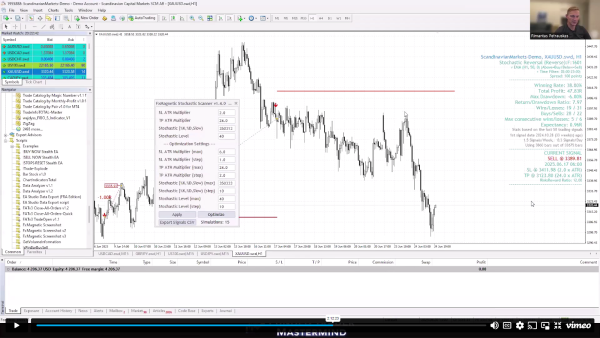
The first step is finding a strategy, or strategies, which meet the criteria for prop firm trading.
Key Metrics to Target:
- Expectancy: 0.6 or higher (minimum for challenge viability)
- Return to Drawdown: 10+ (indicates robust performance)
- Max Consecutive Losses: 6 or fewer (manageable risk)
- Risk-to-Reward: 1:2 minimum (essential for profitability)
- Signal Frequency: 3-7 signals per week (optimal for challenges)
With these benchmarks established, here’s how to systematically discover qualifying strategies:
The FxMagnetic Scanner Process:
- Run FxMagnetic Scanner on multiple timeframes (15M, 1H, 4H).
- Filter results based on the key metrics above
- Export promising strategies for deeper analysis
- Use ChatGPT analysis (prompt provided) to validate if the strategy fits the criteria
🤖 Step 2: Semi-Automated Execution Setup
Once a strategy, or strategies, passes the screening, you can run the FxMagnetic Autotrader to automate the strategy.
Risk Management Configuration:
At this stage, you can begin fine-tuning the strategy parameters.
- Risk per Trade: 0.5-1% (adjusted based on strategy’s max drawdown)
- Daily Loss Limit: Set to prevent rule breaches
- Strategy Stop Conditions: Max consecutive losses + 1-2 buffer
Benefits Of Automation In The Semi-Automation:
- No manual trade entry required
- Consistent execution without emotional interference
- 24/7 monitoring and execution
- Automatic risk management application
📈 Step 3: The Real Challenge Journey
Here’s the exact steps with time stamps on how I tested multiple strategies systematically until I found one which passed the FTMO challenge.
Strategy #1: Pin Bar Strategy (April 11 – May 8)
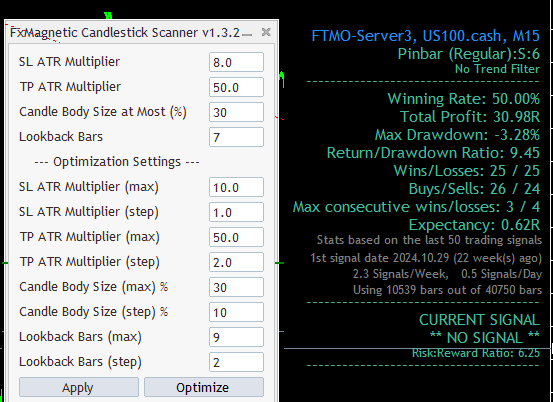
- Account: $10,000 FTMO Challenge
- Initial Stats: Excellent backtest statistics – 50% win rate, 6.25R risk-reward, 9.45 return/drawdown ratio
- Risk Management: 1.5% per trade
- Outcome: ❌ Passed challenge but disqualified for breaching daily limit by $4
- Key Lesson: Even winning strategies need precise risk management
- Problem: Two trades overlapped same day, creating combined drawdown exceeding daily limits
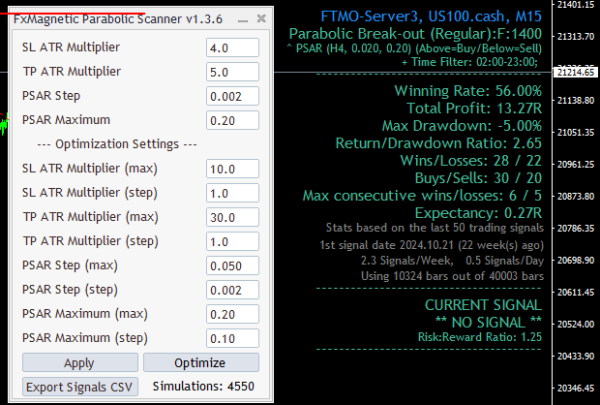
Strategy #2: Parabolic SAR Strategy (May 8 – May 27)
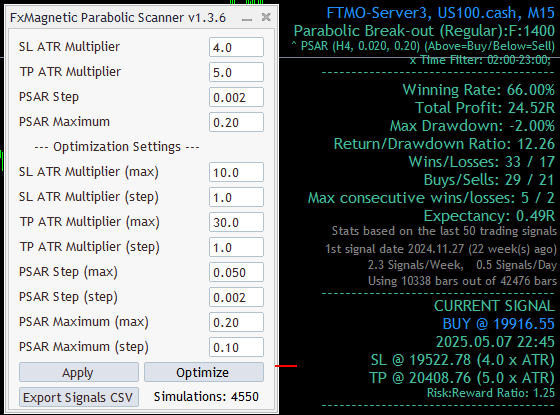
- Account: $25,000 FTMO Challenge (restart)
- Initial Stats: 66% win rate, but low risk-to-reward ratio (1.25R)
- Performance: Account dropped from $25,000 by approximately $700 to $24,300, return to drawdown fell to 2.65
- Outcome: ❌ Strategy stopped due to poor performance
- Duration: Approximately 19 days
- Lesson: Low risk-reward strategies struggle to maintain edge
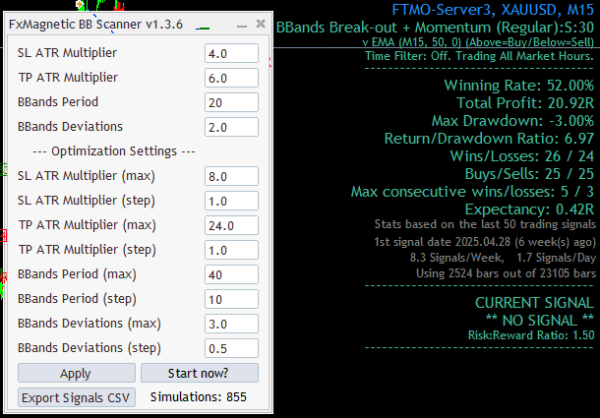
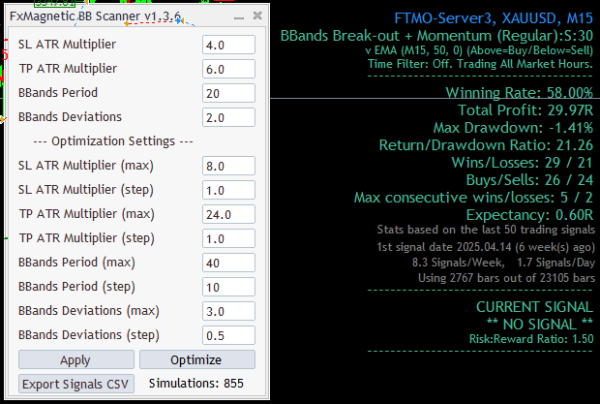
Strategy #3: Bollinger Band Strategy (May 27 – June 4)
- Continuation: Same $25,000 account (starting from $24,829.31)
- Initial Stats: 58% win rate, 1.50 risk-reward ratio
- Performance: 14 trades executed, ended losing -$13.57
- Outcome: ❌ Strategy abandoned – essentially breakeven performance
- Duration: 8 days
- Lesson: Weak expectancy strategies waste time and emotional energy
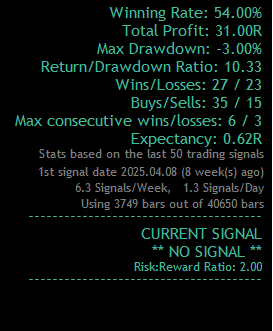
Strategy #4: The Winner (June 4 – June 23)
- Continuation: Same $25,000 account (started from $24,815.74 after previous losses)
- Strategy Type: FxMagnetic Parabolic Scanner-based system
- Final Stats:
- 54% win rate
- Risk-reward ratio: 2.00
- Expectancy: 0.62R
- Max consecutive losses: 3
- Return to drawdown: 10.33
- Trading frequency: 6.3 signals per week
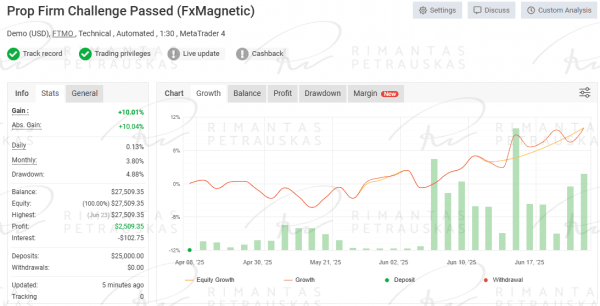
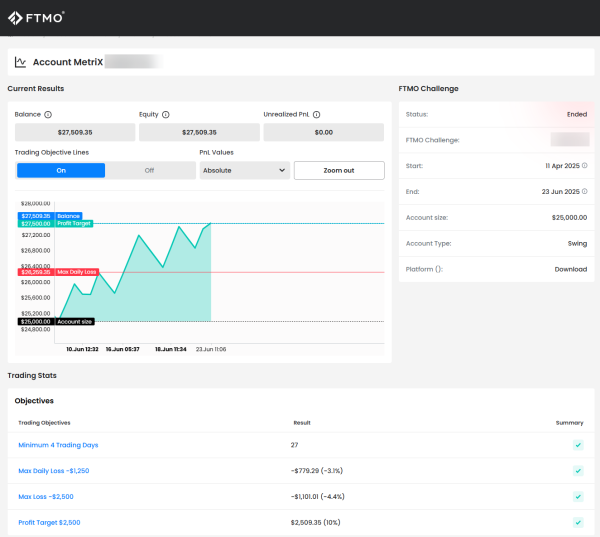
- Outcome: ✅ Successfully passed challenge in 19 calendar days
- Final Balance: $27,509.35
- Key Success Factor: Strategy maintained consistent metrics throughout testing period
Critical Insights from the Journey:
- Persistence Required: Took 4 different strategies over 2+ months
- Risk Precision Matters: $4 breach shows importance of exact calculations
- Expectancy is King: Low expectancy strategies (0.4-0.6) proved insufficient
- Consistency Beats Perfection: Final strategy wasn’t perfect but was reliable
- Documentation Value: Tracking each attempt provided learning insights
⏰ Weekly Management Routine (1 Hour Total)
The beauty of this system is its minimal time requirement. Here’s a sample trading routine you can follow:
Sunday Evening Review (30 minutes):
- Weekly performance summary
- Update risk dashboard
- Prepare for following week’s trading
- Assess upcoming economic data and potential volatility
Mid-Week Check (15 minutes):
- Quick glance at open positions
- Verify auto-trader is functioning correctly
- Monitor for any unusual market conditions
Friday Assessment (15 minutes):
- Check strategy performance metrics
- Compare live results to backtest expectations
- Document any changes in win rate or drawdown
- Plan any strategy rotations if needed
🔄 Strategy Rotation Protocol
The key to success is knowing when to switch strategies:
When to Stop a Strategy:
- Max consecutive losses exceeded (backtest max + 2)
- Return to drawdown drops below 5
- Win rate diverges significantly from backtest
- Strategy shows 3+ weeks of poor performance
Strategy Transition Process:
- Stop current auto-trader
- Run new FxMagnetic Scanner search
- Analyze top 3-5 candidates using ChatGPT
- Select best candidate based on risk profile
- Configure new auto-trader setup
- Resume semi-automated trading
💡 The ChatGPT Analysis Revolution
One of the biggest game-changers was using AI for strategy analysis: We took as screenshot of the result and using a prompt to generate recommendations (improvements, targets, etc.):
The Analysis Prompt Process:
- Take screenshot of strategy statistics
- Input into ChatGPT with custom prompt to assess performance
- Receive detailed analysis including:
- Risk compatibility assessment
- Projected time to reach profit target
- Emotional guardrails and rules
- Strategy improvement suggestions
Sample ChatGPT Insights:
- “Strategy requires 11 trades to reach 10% target”
- “Max consecutive losses of 6 puts daily drawdown at risk”
- “Recommended risk: 0.5% per trade for safer margins”
- “Estimated duration: 7-8 weeks to complete challenge”
🎯 Final Results: The Numbers
Key Success Principles:
- Survival Focus: Risk management keeps you in the game
- Systematic Approach: Remove emotions from decisions
- Patient Execution: Allow your edge to play out over time
- Disciplined Rotation: Know when to switch strategies
Realistic Timeline:
- Learning Phase: 2-4 weeks to understand your system
- Completion: 8-16 weeks total for challenge success
- Time Investment (after learning phase): 1 hour per week average
🚀 Replicating This Success
Required Tools:
- FxMagnetic Scanner (strategy discovery)
- FxMagnetic Autotrader (execution)
- ChatGPT account (analysis)
- Simple spreadsheet (tracking)
Critical Success Mindset:
- Trust the process over individual trade results
- Focus on system execution not prediction
- Maintain discipline during drawdown periods
- Think like a fund manager not a gambler
📝 Final Thoughts
This semi-automated approach transforms any Prop Firm challenge completion from a stressful, time-consuming endeavor into a systematic, time-saving, and manageable process. The key is combining proven technology (FxMagnetic tools) with disciplined risk management and objective decision-making.
Remember: You’re not trying to predict the market—you’re managing a portfolio of systematically-tested strategies with proper risk controls. The semi-automation handles strategy building and executions while you focus on the higher-level management decisions. This semi-automated approach embodies that patience through systematic execution.
“The market is a device for transferring money from the impatient to the patient.”
